Ten years ago, a room lined floor to ceiling in pink salt was a curiosity you’d find in a handful of destination spas. Now it’s becoming one of the staples of any well-appointed wellness destination.
Walk into a hotel spa in Sedona, Carlsbad, Houston or lower Manhattan and there’s a decent chance you’ll find a salt room tucked between the sauna and the relaxation lounge, and that you can book a day pass into it without staying the night. And with that, halotherapy is becoming vastly more accessible—not as a treatment package or a two-night minimum, just in an afternoon.
Salt room benefits are also one of the more oversold topics in wellness, so it’s important to know what the research says vs. what you might have heard proclaimed on TikTok. Some of what gets claimed has been measured in controlled trials. A good deal of it hasn’t.
Read on to learn what a salt room is, what the research supports and what it doesn’t, what a session feels like, and where to try one for a day.
Key takeaways
- A salt room uses a halogenerator to grind pharmaceutical-grade salt into microscopic particles and disperse them into dry, cool air. You sit and breathe.
- The best evidence is respiratory: A double-blind pediatric trial found improvements in airway reactivity and quality of life, though not in lung function tests. Claims about skin, sleep and immunity are far thinner.
- Sessions typically run 30 to 45 minutes, ask nothing of you beyond comfortable clothing, and pair naturally with a sauna, steam room or thermal circuit on the same visit.
What is a salt room?
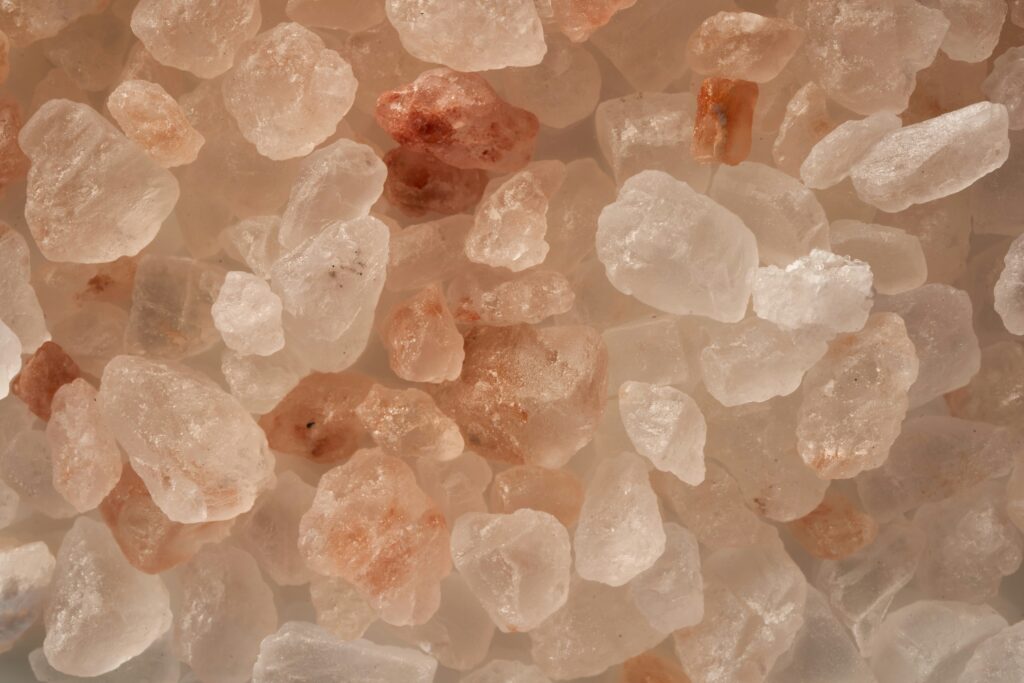
A salt room is a controlled indoor environment where a device called a halogenerator grinds pure sodium chloride into particles a few micrometers across and releases them into dry, cool, low-humidity air. You sit in a reclining chair, breathe normally for half an hour or so, and leave. The practice is called halotherapy, from halos, the Greek word for salt.
The idea traces back to Eastern European salt mines. In the 1840s a Polish physician noticed that salt miners had markedly less respiratory illness than the population around them, and by the mid-twentieth century “speleotherapy,” or therapeutic time spent in underground salt caves, was an established part of sanatorium medicine across Poland, Russia and Ukraine. The halogenerator, developed in the Soviet Union in the 1980s, was an attempt to reproduce that environment above ground. Spa salt rooms are its commercial descendants.
One distinction matters before you book. Dry and wet salt therapy get used interchangeably in marketing copy, and they’re not the same thing.
| Dry salt therapy (halotherapy) | Wet salt therapy |
|---|---|
| A halogenerator disperses dry salt particles into the air | Uses saline solutions, salt water pools, or inhalers |
| Takes place in a salt-lined room with salt on the walls and floor | Delivered through gargling, nasal rinses, or soaking |
| No contact with water or moisture | Involves direct contact with water |
| Aimed at relaxation, respiratory support, and skin exposure | Aimed at targeted nasal and sinus relief |
| Passive: you sit or recline for the session | Active: you participate by rinsing or soaking |
| Typical session runs 30 to 45 minutes | Varies, often a few minutes for a rinse or inhaler |
Himalayan salt rooms, and what the pink walls are doing
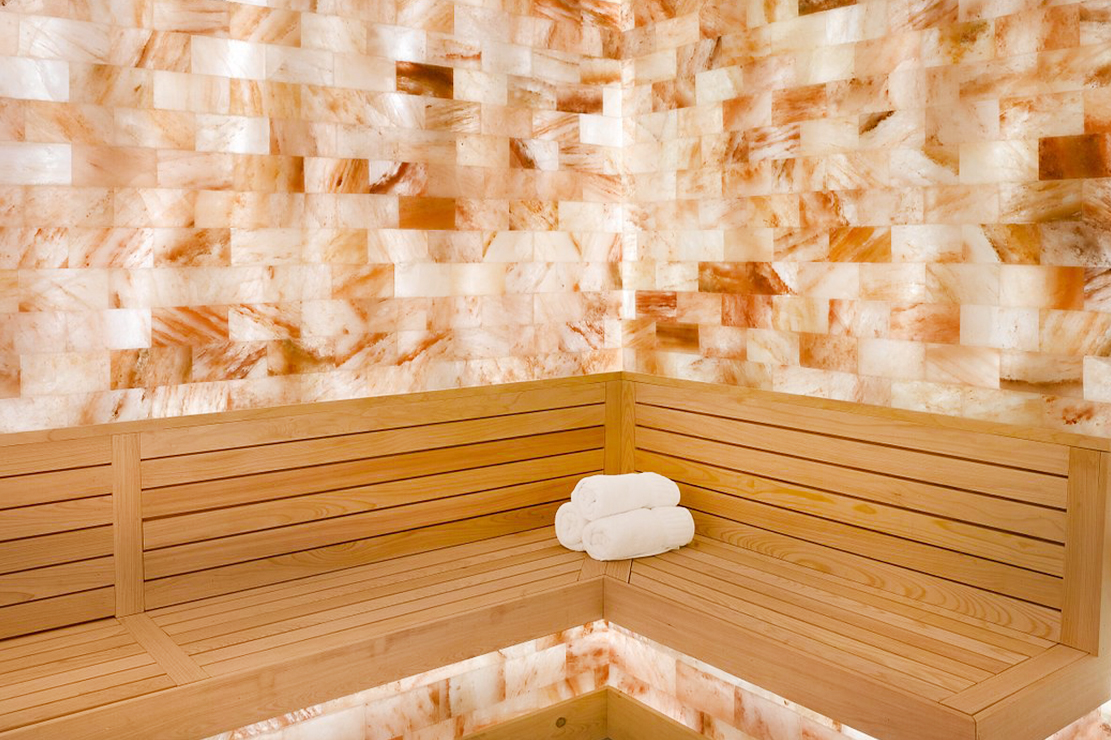
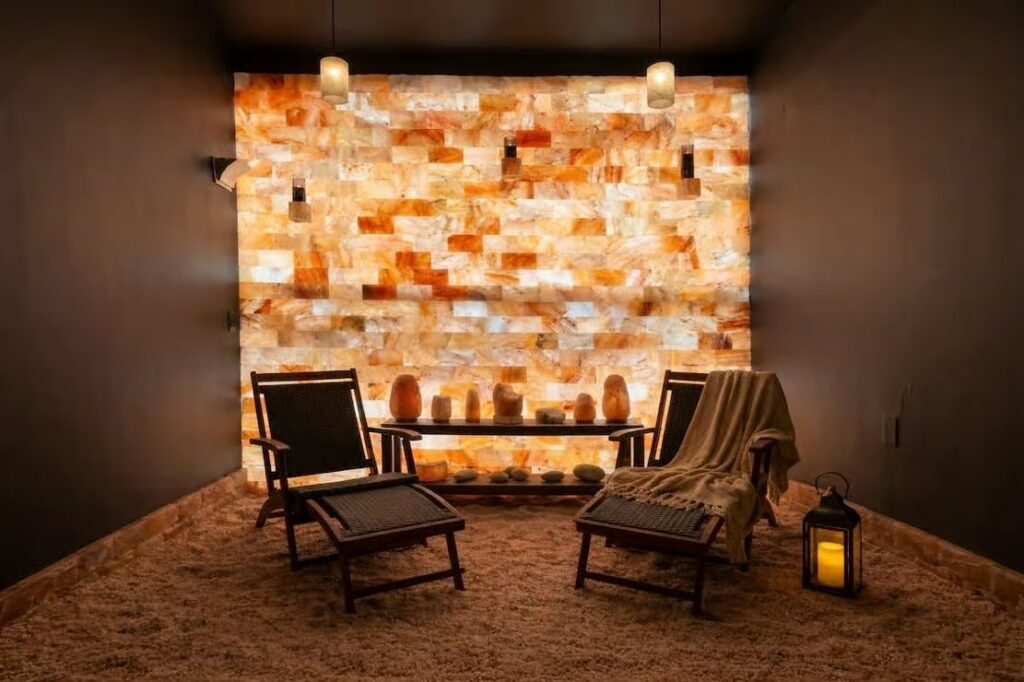
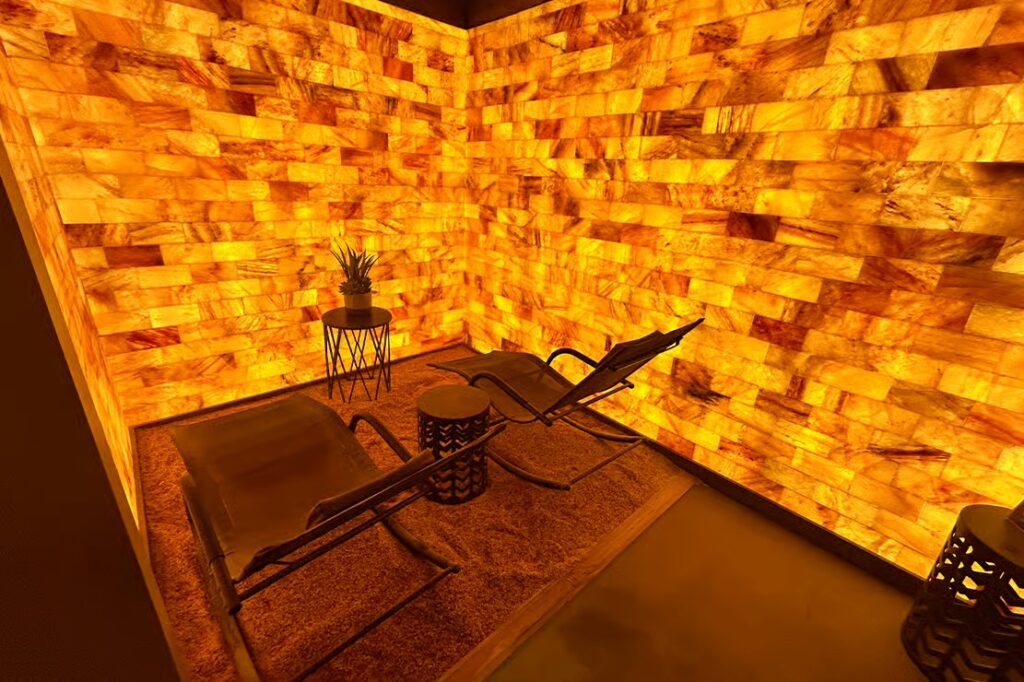
Plenty of spa salt rooms are built from pink Himalayan salt: blocks stacked into walls, backlit panels, a few inches of loose salt crystals underfoot. It’s a striking room to sit in, and it’s the image most people picture when they hear “salt room.”
It’s worth being clear-eyed about which part is which. The therapeutic mechanism, to whatever extent there’s one, comes from the halogenerator and the particles you breathe. The Himalayan salt on the walls is architecture: it holds humidity down, it looks extraordinary under warm light, and it makes the room feel like somewhere distinct from the hallway you walked in from. Himalayan salt room benefits are halotherapy benefits plus a better room, and the second half of that is not nothing, since the environment is a real part of why people find these sessions restorative. It just isn’t a separate mineral effect, and any spa telling you the trace minerals in the wall are absorbed through your skin is telling you something the evidence doesn’t support.
What the research shows
Halotherapy sits in an awkward evidential spot: enough positive signal to be interesting, not enough rigor to be settled. Being straight about that is more useful than a benefits list.
The most credible trial is a double-blind study in Pediatric Pulmonology (Bar-Yoseph et al., 2017). Fifty-five children with mild asthma spent 14 sessions over seven weeks in a salt room; the treatment group’s room had a working halogenerator and the control group’s didn’t, so both groups got the same room, the same chairs and the same quiet. The treatment group showed a statistically significant improvement in bronchial hyper-responsiveness and in most quality-of-life measures, and no improvement in spirometry or exhaled nitric oxide. The authors called for larger trials rather than overstating what they’d found (doi:10.1002/ppul.23621).
A review in the International Journal of Chronic Obstructive Pulmonary Disease (Rashleigh et al., 2014) went looking for evidence in COPD and mostly found out how thin the literature is: of 151 articles screened, exactly one randomized controlled trial met inclusion criteria, and the authors had to widen the criteria to three case-control studies to say anything at all. Pooled across four studies and 1,041 participants, they couldn’t recommend halotherapy as a COPD therapy on the evidence available (doi:10.2147/COPD.S57511).
More recently, a randomized controlled trial in Life (Sar???k et al., 2026) added 45-minute halotherapy sessions three times a week to 12 weeks of preseason training for 28 elite female footballers. The halotherapy group improved significantly more than the training-only control in respiratory muscle strength, FEV1, peak expiratory flow and estimated VO2max. Small, single-team, and impossible to blind, so it’s a signal rather than a settled finding, but a properly randomized one (doi:10.3390/life16081233).
All three are about breathing. The skin claims rest on different ground; learn more below.
The benefits of a salt room
Respiratory support
This is the claim with the most evidence behind it. The proposed mechanism is that fine salt particles reaching the airways draw in moisture and thin mucus, which makes a cough more productive and helps clear the airway. Trials have found improvements in airway reactivity and in how people say they feel, if not consistently in lung function measurements.
In practice, people book salt rooms during allergy season, after a stretch of poor air quality, or when a cold is on its way out and the congestion is lingering. If you’re a regular in a thermal circuit, a salt room slots in as the quiet, dry counterweight to the steam room. One thing to keep in mind: a mild increase in coughing during or just after a session is common and expected, not a sign anything’s gone wrong.
Skin health
The skin research cited for salt rooms is mostly research about salt bathing, not salt air. A clinical trial in the International Journal of Dermatology (Proksch et al., 2005) had volunteers with atopic dry skin soak one forearm in a 5% Dead Sea salt solution and the other in tap water, 15 minutes at a time over six weeks. The salt-treated arm showed improved barrier function in the subgroup with elevated water loss, better hydration, and reduced roughness and redness (doi:10.1111/j.1365-4632.2005.02079.x).
That’s a real result about submerging skin in mineral-rich water, but it’s not the same thing as sitting in dry salt air. Some people with eczema or psoriasis do report that salt rooms leave their skin calmer, but dermatologists at major health systems have been consistent that the studies for dry salt and skin don’t exist yet. Try it if you’re curious, but don’t expect a skin miracle.
Stress relief and quiet
The least contested benefit is also the least exotic. A salt room is a dim, warm-lit, low-stimulation space with no screens, no conversation and nothing asked of you for 40 minutes. That does reliable things to a nervous system, and it doesn’t require the salt to be doing anything at all.
Which is worth saying plainly, because the honest truth is this: if you leave a salt room feeling better, a good deal of that is the room, and the room is a legitimate reason to go. A few simple mindfulness techniques turn 40 minutes of sitting into a restorative practice.
Americans run about 6,600 Google searches a month for “halotherapy,” 9,900 for “salt cave,” and 4,400 for “salt room near me” as of September 2026. Curiosity about salt rooms is only just beginning.
Better sleep
There’s no direct trial evidence that salt rooms improve sleep. What there is: a well-documented relationship between evening wind-down and sleep quality, plus a lot of people who report sleeping unusually well after a spa afternoon. A salt room works the way a sauna or a long soak works—through relaxation rather than the salt specifically. If sleep is the goal, book late afternoon rather than first thing.
Immune support
This is the weakest of the five claimed benefits, and better treated as a self-reported pattern than a finding. Regular users often say they get fewer colds, and there are plausible-sounding mechanisms involving mucociliary clearance and the antibacterial properties of salt. None of it has been demonstrated in controlled trials in healthy adults. Treat halotherapy as a complement to the things that do have evidence behind them, never as a substitute for medical care.
What a salt room session is like
The mechanics are simple enough that first-timers are often surprised there isn’t more to it.
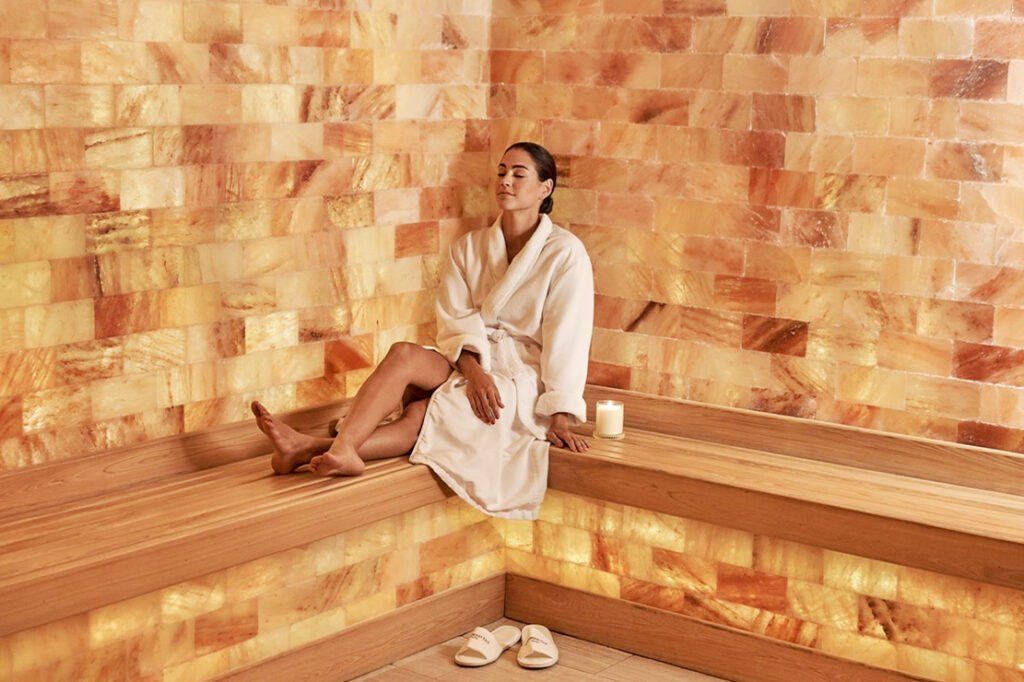
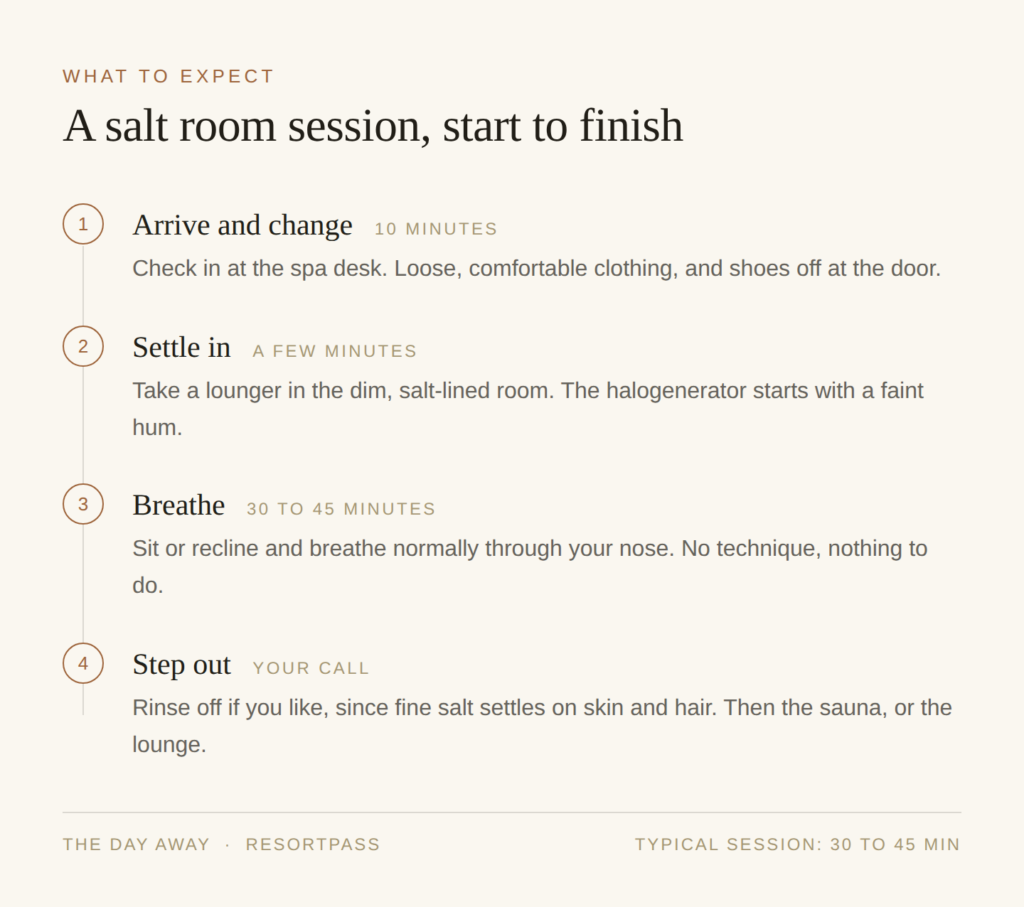
What to wear: Comfortable, loose clothing, and something warm enough that you’re not chilly sitting still; salt rooms run cool and dry by design. Many spas provide a robe and slippers with a day pass. Socks or bare feet are both fine, and you’ll want to leave shoes at the door since the floor is usually loose salt. Fine salt residue settles on dark fabric and shows, so light colors are the practical choice.
What to bring: Water, if the spa allows it, and a book if the room is lit well enough, though many aren’t. Most people bring nothing. Phones are generally discouraged, and the room works better without one.
The setting: Dim lighting, often with the salt walls backlit. Reclining chairs or loungers, sometimes zero-gravity ones. Ambient sound, occasionally silence. You might be alone or sharing with a handful of other people, and the etiquette is quiet either way.
What happens: The halogenerator runs, usually with a faint hum, and disperses salt into the air. You sit or recline and breathe normally through your nose. There’s no technique to learn and nothing to do. Some people meditate, some nap, most drift.
How long: Typically 30 to 45 minutes. First-timers might start at the shorter end to see how they respond.
Salt rooms are easy to build a longer visit around. Most properties that have one also have a sauna, steam room or hydrotherapy pool, and the standard move is to alternate: sauna for the heat, salt room for the quiet, cold plunge if you’re feeling brave. Add a treatment and you’ve got an afternoon; our guide to the spa daycation covers how to sequence it.
Where to try a salt room for the day
You don’t need a hotel reservation or a treatment booking to sit in a salt room. A ResortPass spa pass gets you into the spa for the day at partner hotels and resorts, which is the lowest-commitment way to find out whether halotherapy belongs in your routine. Each of these seven sells a day pass that gets you to the salt room.
- Apollo House NYC, New York, NY. A Broadway wellness house with a thermal suite: traditional sauna, steam room, hot tub and a quiet salt room, plus a fitness center. One of the more affordable ways into a spa day in Manhattan, and if you’re comparing options, our roundup of the best spas in NYC has more.
- Hard Rock Hotel & Casino Atlantic City, Atlantic City, NJ. The most direct option on this list: alongside the Rock Spa wellness pass, there’s a bookable halotherapy salt chamber session with full spa access, so the salt room is the reservation rather than an amenity you hope is open.
- The Spa at The Fountains Resort, Orlando, FL. The spa pass covers pool access, a cold plunge and a restorative salt room, which is a useful combination after a few days of theme parks.
- Woodhouse Spa – Houston Galleria, Houston, TX. A dedicated halotherapy salt room, plus a unisex infrared sauna, private relaxation tubs and a lounge, all inside the Galleria.
- Southwest Inn at Sedona, Sedona, AZ. An adults-only boutique retreat with red rock views, where salt therapy books as its own short session alongside the heated pool, sauna and cold plunge.
- Omni La Costa Resort & Spa, Carlsbad, CA. The full-day spa pass runs the whole thermal circuit: Himalayan salt rooms, a reflexology pathway, Roman waterfall showers, Mind-Sync relaxation chairs and a private spa pool, across 400 acres.
- Fairmont Century Plaza, Los Angeles, CA. A Himalayan salt room sits alongside a cedar sauna, eucalyptus steam, a modern hammam and marble relaxation spaces, and the pass includes pool access.
Amenity lists and pass types shift, so check what’s included on the listing before you book. You can filter for a salt room directly on the spa search, and a spa pass near you will show what’s bookable on your dates.
Ready to unwind? Find a spa near you and breathe easy with your next salt room session.
Salt room benefits: FAQs
How long should you sit in a salt room?
A typical salt room session runs about 30 to 45 minutes, which is long enough to settle into the quiet without feeling stuck. First-timers often start with a shorter session to see how their body responds. People who make halotherapy a habit tend to go weekly or every other week rather than daily.
What are you supposed to do in a salt room?
Nothing, which is the point. You sit or recline in a chair and breathe normally through your nose. There’s no technique, no posture and no equipment. Some people meditate, some read if the light allows, some fall asleep. Phones are usually discouraged, and the session is more restorative without one.
Should you shower after a salt room?
It isn’t strictly necessary, but many people rinse off afterward since fine salt residue settles on skin and hair. If you have sensitive skin, showering after a session can help prevent irritation. Most spas with a salt room have showers in the locker area, so it’s easy either way.
Who should not use salt therapy?
Salt therapy is generally considered safe for most people, but anyone with a significant respiratory condition such as severe asthma or COPD should check with a doctor first, as should people with open wounds or high blood pressure. Pregnant individuals are also advised to consult their physician before trying halotherapy. If you’re claustrophobic, ask about the size of the room before booking. As with any wellness treatment, personalized guidance from a healthcare provider is worth getting if you have underlying health conditions.
What should you wear in a salt room?
Comfortable, loose-fitting clothing, ideally in a light color, since salt residue shows on dark fabric. Many spas provide a robe and slippers with a day pass. Salt rooms are kept cool and dry, so bring a layer if you tend to run cold sitting still.
Do salt rooms work?
It depends what you’re asking them to do. For respiratory symptoms, a double-blind trial in children with mild asthma found improvements in airway reactivity and quality of life, though not in lung function tests, and reviewers looking at COPD concluded the evidence isn’t strong enough to recommend it as a therapy. For relaxation, the answer is simpler: a dim, quiet, screen-free room does what dim, quiet, screen-free rooms do. Go in with the second expectation and you won’t be disappointed.
Is a salt room the same as a salt cave?
More or less, in commercial use. “Salt cave” usually describes a room built to feel cave-like, with salt walls, dim lighting and sometimes a curved ceiling. “Salt room” is the plainer term for the same setup. Both typically run a halogenerator. True speleotherapy, the original practice, takes place in actual underground salt mines, and there are only a handful in the world.
Sources cited
Bar-Yoseph R, Kugelman N, Livnat G, Gur M, Hakim F, Nir V, Bentur L. Halotherapy as asthma treatment in children: a randomized, controlled, prospective pilot study. Pediatric Pulmonology. 2017;52(5):580–587. https://doi.org/10.1002/ppul.23621
Rashleigh R, Smith SMS, Roberts NJ. A review of halotherapy for chronic obstructive pulmonary disease. International Journal of Chronic Obstructive Pulmonary Disease. 2014;9:239–246. https://doi.org/10.2147/COPD.S57511
Sar???k DÇ, Ayd?n AS, Söyler M, Zileli R, Özkurt A, Y?lmaz C, Küçük H, Karata? M. Effects of halotherapy as an adjunct to preseason training on respiratory and aerobic outcomes in elite female football players: a randomized controlled trial. Life. 2026;16(8):1233. https://doi.org/10.3390/life16081233
Proksch E, Nissen HP, Bremgartner M, Urquhart C. Bathing in a magnesium-rich Dead Sea salt solution improves skin barrier function, enhances skin hydration, and reduces inflammation in atopic dry skin. International Journal of Dermatology. 2005;44(2):151–157. https://doi.org/10.1111/j.1365-4632.2005.02079.x