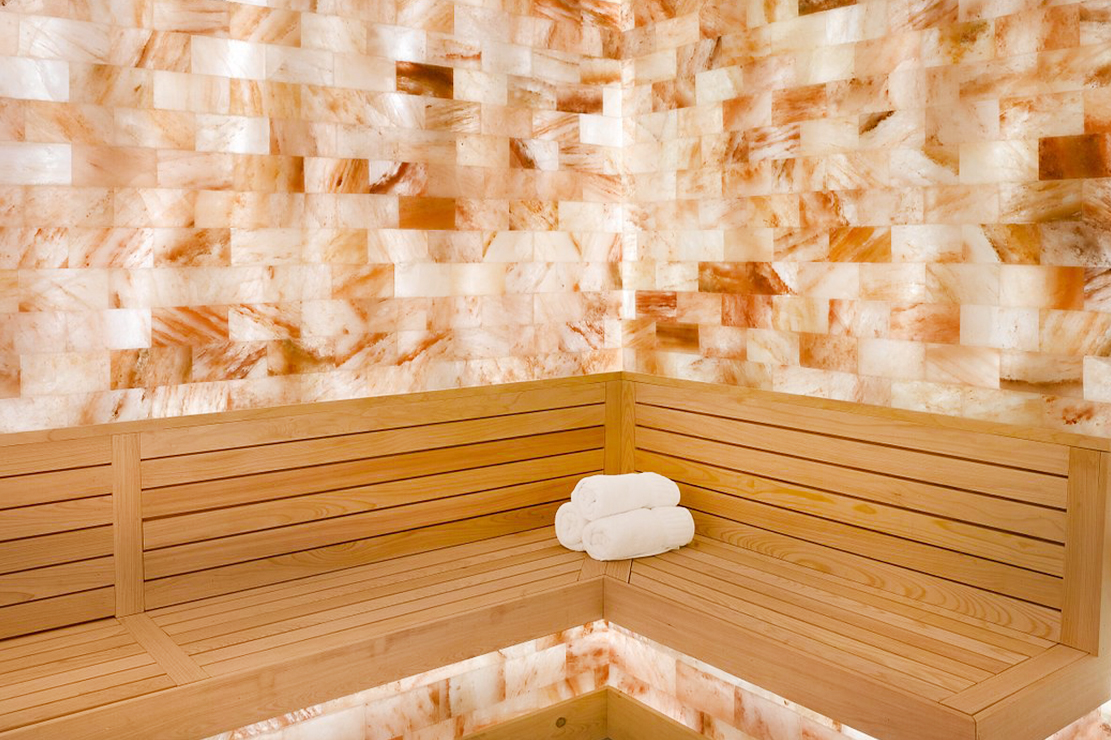
A room lined floor to ceiling in pink salt used to be a novelty found in a handful of destination spas. Now it’s a staple: hotel spas from Sedona to lower Manhattan tuck a salt room between the sauna and the relaxation lounge, bookable on a day pass with no overnight stay required.
Salt room benefits are also one of the more oversold topics in wellness. Some claims hold up in controlled trials; plenty don’t. Here’s what the research actually shows, what a session feels like, and where to book one.
Key takeaways
- A halogenerator grinds pharmaceutical-grade salt into microscopic particles and disperses them into dry, cool air. You sit and breathe.
- The best evidence is respiratory: a double-blind pediatric trial found improved airway reactivity and quality of life, though not lung function. Claims about skin, sleep and immunity are thinner.
- Sessions run 30–45 minutes, need nothing but comfortable clothing, and pair naturally with a sauna or steam room.
What is a salt room?
A salt room is a controlled space where a halogenerator grinds pure sodium chloride into particles a few micrometers wide and releases them into dry, cool, low-humidity air. You sit in a reclining chair and breathe normally for about half an hour. The practice is called halotherapy, from halos, the Greek word for salt.
The idea traces back to Eastern European salt mines: a 19th-century Polish physician noticed miners had less respiratory illness than the general population, and “speleotherapy” — time in underground salt caves — became standard sanatorium medicine across Poland, Russia and Ukraine. The halogenerator, developed in the Soviet Union in the 1980s, recreates that environment above ground; spa salt rooms are its commercial descendant.
Dry and wet salt therapy get used interchangeably in marketing copy, but they’re not the same thing:
| Dry salt therapy (halotherapy) | Wet salt therapy |
|---|---|
| A halogenerator disperses dry salt particles into the air | Uses saline solutions, salt water pools, or inhalers |
| Takes place in a salt-lined room with salt on the walls and floor | Delivered through gargling, nasal rinses, or soaking |
| No contact with water or moisture | Involves direct contact with water |
| Aimed at relaxation, respiratory support, and skin exposure | Aimed at targeted nasal and sinus relief |
| Passive: you sit or recline for the session | Active: you participate by rinsing or soaking |
| Typical session runs 30 to 45 minutes | Varies, often a few minutes for a rinse or inhaler |
Himalayan salt rooms, and what the pink walls are doing
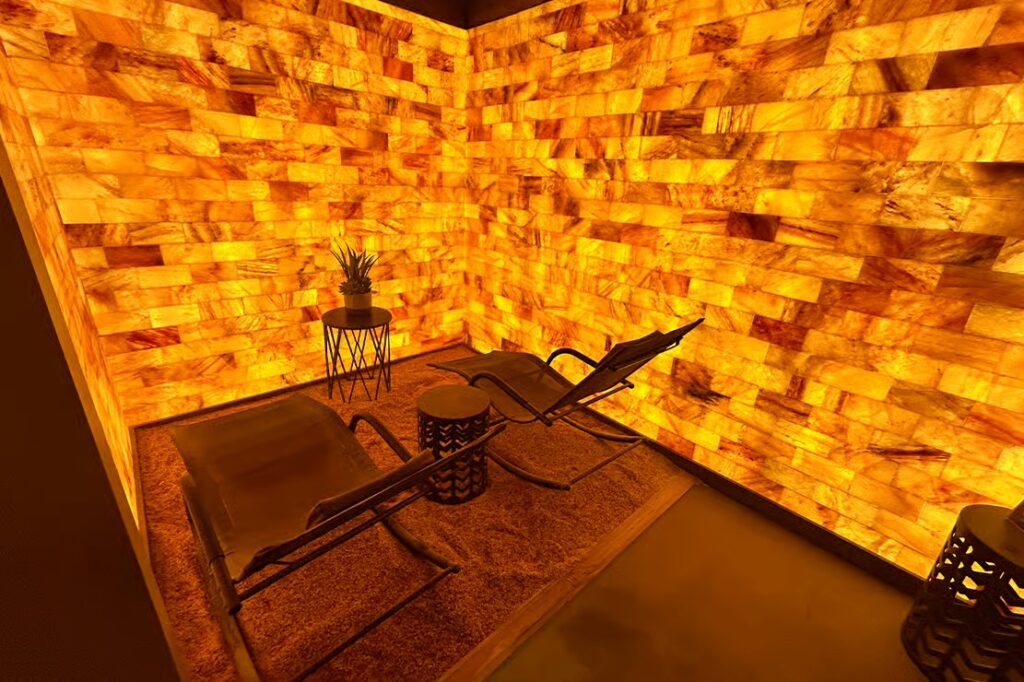
Plenty of spa salt rooms are built from pink Himalayan salt — blocks stacked into walls, backlit panels, loose crystals underfoot. It’s the image most people picture when they hear “salt room,” but it’s worth knowing which part does what: the therapeutic mechanism, to whatever extent it exists, comes from the halogenerator and the particles you breathe. The Himalayan salt on the walls is architecture — it controls humidity and looks striking under warm light, but there’s no separate mineral effect. Any spa claiming you absorb trace minerals through your skin is stretching the truth.
What the research shows
Halotherapy sits in an awkward spot: enough positive signal to be interesting, not enough rigor to be settled.
The strongest trial is a double-blind study in Pediatric Pulmonology: 55 children with mild asthma spent 14 sessions over seven weeks in matched rooms, one with a working halogenerator and one without. The treatment group showed statistically significant improvement in airway reactivity and most quality-of-life measures, though not in spirometry or exhaled nitric oxide.
A review in the International Journal of Chronic Obstructive Pulmonary Disease found the COPD literature too thin to lean on: of 151 articles screened, only one randomized trial qualified, and even widening the criteria to case-control studies yielded just four studies and 1,041 participants — not enough to recommend halotherapy as a COPD therapy.
A more recent randomized trial in Life added 45-minute halotherapy sessions, three times a week, to 12 weeks of preseason training for 28 elite female footballers. The halotherapy group improved significantly more than the training-only control in respiratory muscle strength, FEV1, peak flow and estimated VO2max.
All three trials are about breathing. The skin, sleep and immunity claims rest on much thinner ground:
The benefits of a salt room
| Benefit | Evidence | Bottom line |
|---|---|---|
| Respiratory support | Strongest | Trials show improved airway reactivity and quality of life; a mild increase in coughing during a session is normal, not a bad sign. |
| Skin health | Indirect | The positive results come from soaking in salt water, not sitting in salt air — dry halotherapy hasn’t been tested the same way. |
| Stress relief | Strong, but generic | A dim, quiet, screen-free room reliably lowers stress — true of any room built that way, salt or not. |
| Better sleep | No direct evidence | Rides on general relaxation, not a salt-specific effect. Book late afternoon if sleep is the goal. |
| Immune support | Weakest | Self-reported only; no controlled trials in healthy adults. |
In practice, people book salt rooms during allergy season or when lingering congestion needs help clearing — if you’re a regular in a thermal circuit, a salt room is the quiet, dry counterweight to the steam room. And a few simple mindfulness techniques can turn a session into something more restorative than just sitting still. Either way, treat halotherapy as a complement to care with stronger evidence behind it, not a substitute for it.
What a salt room session is like
The mechanics are simple enough that first-timers are often surprised there isn’t more to it.
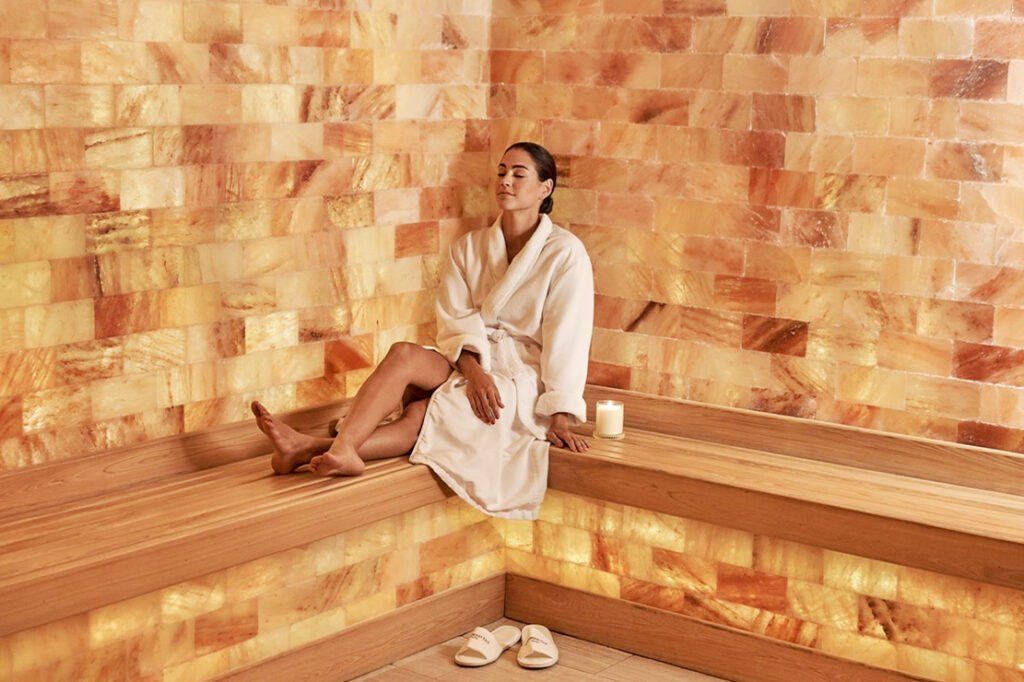
What to wear: Comfortable, loose clothing in light colors — salt residue shows on dark fabric — plus a layer, since salt rooms run cool and dry. Many spas provide a robe and slippers with a day pass; leave shoes at the door, since the floor is usually loose salt.
What to bring: Water, if allowed, and not much else — phones are generally discouraged, and the room works better without one.
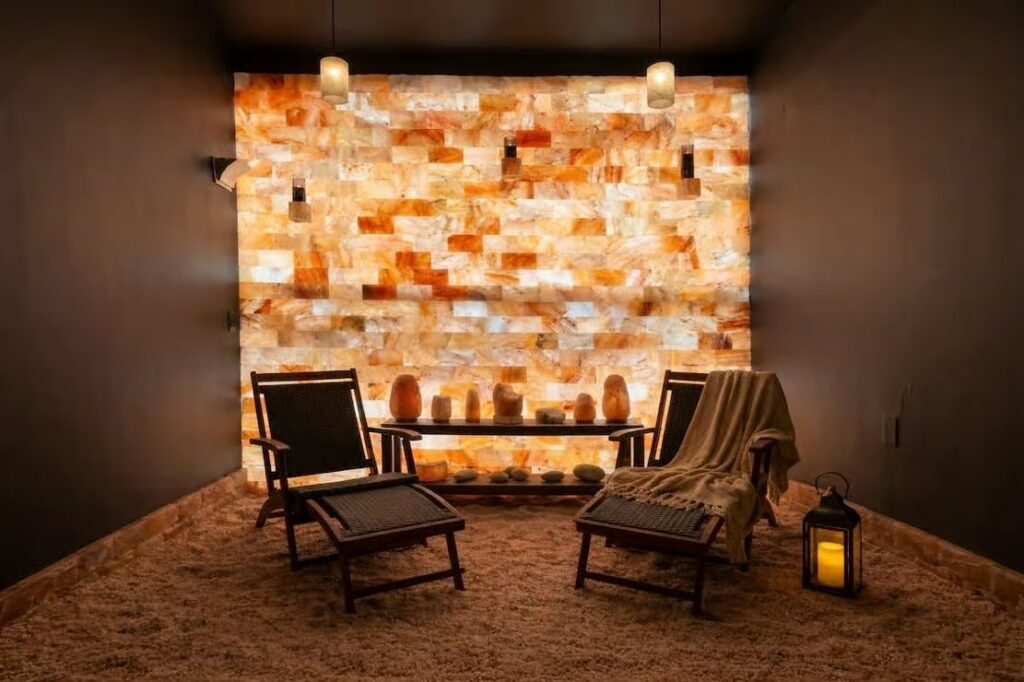
The setting: Dim lighting, often with backlit salt walls, reclining or zero-gravity chairs, and ambient sound or silence. You might be alone or sharing the room with a few others; the etiquette is quiet either way.
What happens: The halogenerator runs with a faint hum, dispersing salt into the air. You sit or recline and breathe normally through your nose — there’s no technique to learn. Some people meditate, some nap, most just drift.
How long: Typically 30 to 45 minutes. First-timers might start shorter to see how they respond.
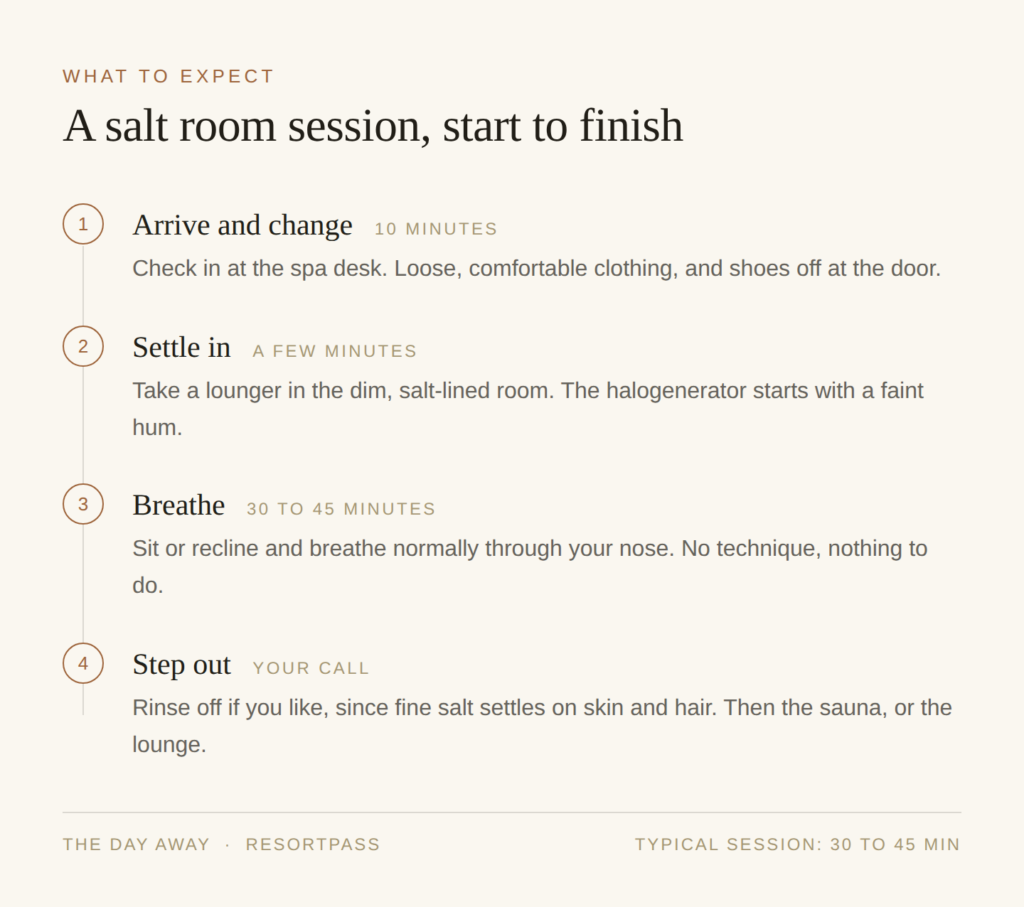
Salt rooms build naturally into a longer visit — alternate sauna for heat, salt room for quiet, and a cold plunge if you’re feeling brave. Add a treatment and you’ve got an afternoon; see our guide to the spa daycation for how to sequence it.
Where to try a salt room for the day
You don’t need a hotel reservation or a treatment booking to sit in a salt room. A ResortPass spa pass gets you into the spa for the day at partner hotels, which is the lowest-commitment way to find out whether halotherapy belongs in your routine. Each of these seven sells a day pass that gets you to the salt room.
- Apollo House NYC, New York, NY. A Broadway wellness house with a thermal suite — sauna, steam room, hot tub, salt room and a fitness center. One of the more affordable spa days in Manhattan; see our roundup of the best spas in NYC.
- Hard Rock Hotel & Casino Atlantic City, Atlantic City, NJ. The Rock Spa wellness pass includes a bookable halotherapy salt chamber session with full spa access — the salt room is the reservation, not an amenity you hope is open.
- The Spa at The Fountains Resort, Orlando, FL. Pool access, a cold plunge and a restorative salt room — a good combination after a few days of theme parks.
- Woodhouse Spa – Houston Galleria, Houston, TX. A dedicated halotherapy salt room plus a unisex infrared sauna, private relaxation tubs and a lounge, all inside the Galleria.
- Southwest Inn at Sedona, Sedona, AZ. An adults-only boutique retreat with red rock views, where salt therapy books as its own session alongside the heated pool, sauna and cold plunge.
- Omni La Costa Resort & Spa, Carlsbad, CA. The full-day spa pass runs the whole thermal circuit: Himalayan salt rooms, a reflexology pathway, Roman waterfall showers, Mind-Sync chairs and a private spa pool, across 400 acres.
- Fairmont Century Plaza, Los Angeles, CA. A Himalayan salt room sits alongside a cedar sauna, eucalyptus steam, a modern hammam and marble relaxation spaces; the pass includes pool access.
Amenity lists and pass types shift, so check what’s included before you book. You can filter for a salt room directly on the spa search, and a spa pass near you will show what’s bookable on your dates.
Ready to unwind? Find a spa near you and breathe easy with your next salt room session.
Salt room benefits: FAQs
How long should you sit in a salt room?
About 30 to 45 minutes: long enough to settle into the quiet without feeling stuck. First-timers often start shorter. People who make it a habit tend to go weekly or every other week rather than daily.
What are you supposed to do in a salt room?
Nothing (that’s the point!). Sit or recline and breathe normally through your nose. No technique, no posture, no equipment needed. Phones are usually discouraged.
Should you shower after a salt room?
It isn’t strictly necessary, but many people rinse off afterward since fine salt residue settles on skin and hair. This is especially helpful if you have sensitive skin. Most spas with a salt room have showers nearby.
Who should not use salt therapy?
Salt therapy is generally considered safe, but anyone with a significant respiratory condition, an open wound or high blood pressure should check with a doctor first, as should pregnant individuals. If you’re claustrophobic, ask about room size before booking.
What should you wear in a salt room?
Comfortable, loose-fitting clothing in a light color, since salt residue shows on dark fabric. Many spas provide a robe and slippers with a day pass; bring a layer, since salt rooms run cool and dry.
Do salt rooms work?
For respiratory symptoms, yes to a meaningful degree: trials show improved airway reactivity and quality of life, though the COPD evidence isn’t strong enough to recommend it as a therapy. For relaxation, the answer is simpler: a dim, quiet, screen-free room does what dim, quiet, screen-free rooms do.
Is a salt room the same as a salt cave?
More or less, in commercial use: “salt cave” just describes a more cave-like build. Both typically run a halogenerator. True speleotherapy takes place in actual underground salt mines, and there are only a handful in the world.
Sources cited
Bar-Yoseph R, Kugelman N, Livnat G, Gur M, Hakim F, Nir V, Bentur L. Halotherapy as asthma treatment in children: a randomized, controlled, prospective pilot study. Pediatric Pulmonology. 2017;52(5):580–587. https://doi.org/10.1002/ppul.23621
Rashleigh R, Smith SMS, Roberts NJ. A review of halotherapy for chronic obstructive pulmonary disease. International Journal of Chronic Obstructive Pulmonary Disease. 2014;9:239–246. https://doi.org/10.2147/COPD.S57511
Sar???k DÇ, Ayd?n AS, Söyler M, Zileli R, Özkurt A, Y?lmaz C, Küçük H, Karata? M. Effects of halotherapy as an adjunct to preseason training on respiratory and aerobic outcomes in elite female football players: a randomized controlled trial. Life. 2026;16(8):1233. https://doi.org/10.3390/life16081233
Proksch E, Nissen HP, Bremgartner M, Urquhart C. Bathing in a magnesium-rich Dead Sea salt solution improves skin barrier function, enhances skin hydration, and reduces inflammation in atopic dry skin. International Journal of Dermatology. 2005;44(2):151–157. https://doi.org/10.1111/j.1365-4632.2005.02079.x